

Hello everyone, Graham here again.
So, what have you been doing during the pandemic, that you always wished you had the time to do? For the last 3 months I’ve been using the Improvement & Coaching Kata to help me improve my guitar playing. It’s been – as they say – quite a journey!
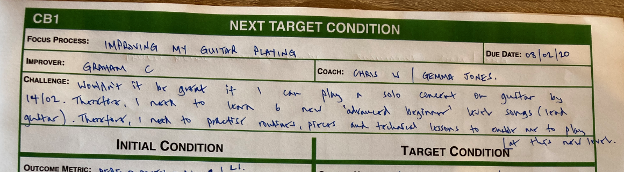
Step 1. Setting the Challenge
From being an almost complete beginner (I had a few lessons 30+ years ago, and have hacked my way through an occasional song since, but not in a way where you’d be able to sing along!), I have reached several Target Conditions on my journey to reaching the Challenge of playing a solo gig for my family. Not just a few 3-chord campfire tunes, or a badly executed version of “Wonderwall”, but some proper tunes with some technical elements that would stretch me. Eeek, my kids are a tough audience – what was I thinking!!
Step 2. Grasping the Current Condition
Establishing the current situation was a little sobering, to say the least! Although, I’d dabbled with guitar playing for years, but I had no ‘habit’ of regular practice, and when I was playing there were a whole heap of bad habits that I’d acquired over the years that were probably holding me back. Furthermore, I’d always ducked the subject of musical theory, so I didn’t really understand ‘why’ I was doing what I was doing – other than just copying what I had seen. If I was going to achieve any progress at all, I needed to go back to ‘school’!
Get A Coach – Be A Coach!
I know through using Toyota Kata myself and starting to coach others in its patterns of thinking, that the role of the Coach is so important. It helps you, as the Improver, ‘stay in the zone’ of learning, checks that you aren’t jumping to conclusions, and that you are following the scientific pattern of hypothesis – experimentation – review, learn and adjust. If you are practicing the Improvement Kata on your own, get a Coach, don’t try to do it on your own. It’ll be the best thing you’ve done for ages if you do. Don’t forget that most professional athletes use a Coach a lot, likewise musicians.
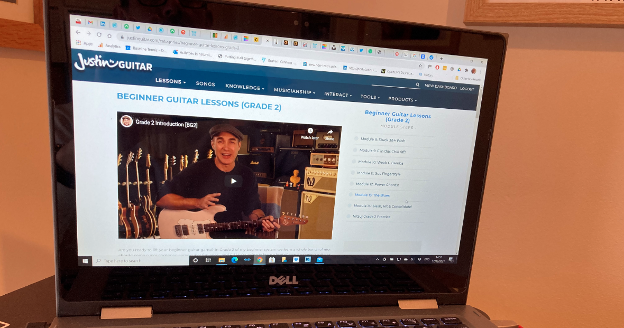
I’ve worked with three Coaches through this project. My first Coach, my online guitar instructor, a quite fantastic Aussie guy (he lives in London now – can we claim him as a Brit, I wonder??) called Justin Sandercoe. The online lessons he provides for budding (and seasoned) guitarists are just remarkable. Mostly free, you donate what you can. He is – although he probably doesn’t even know it – a Kata Geek. Boy, developing my skills through his teaching, I’ve really come to know the importance of ‘deliberate practice’, and the learning zone being just beyond the comfort zone! But more of that later. Most of all he is just joyful about playing and learning the guitar, and his optimism and humour has helped get me through not just this challenge, but the challenge of living in lockdown twice during the time of this project!
My next two Coaches were Gemma Jones and Chris Wardle. We’ve been on a “journey” of discovery around TK and Scientific Thinking together for the last 9 months, and they have taken turns at being my Kata Coach. I just want to thank them – on the record – for their support and patience in getting me to my Challenge. How great to learn from you along the way. Cheers guys.
Step 3. Establishing the First Target Condition
So back to the IK steps. My first Target Condition was based on developing a new habit for practice. This would help me proceed through the beginner lessons of Justin’s Beginner Grade 1 course. But the ‘process’ metric for this was time spent every day practicing.

I soon encountered quite a few obstacles! One of my guitars (I have 3) just sounded awful. I was sure it wasn’t just that I was a terrible player, I was, but not as bad as that. So, my next step was to find a guitar doctor who could look at the set up for me. He set it up to sound, and to play, better than ever (I’ve had it about 5 years and it’s always bugged me how it didn’t sound right). Several learnings right there. I now had a beautifully set-up instrument and made a great connection with a small business that can help me with guitar issues in future. Take the time to get your process in control and stable before you embark on your next steps. If it’s an obstacle, and it’s holding you back, fix it first!
Step 4. Experimenting Toward the Target Condition
To begin with, my experiments were all about trying to find the ‘best’ time for me to practice. Committing the time to practice was going to be the only way I was going to progress, so it was important to make this as easy to achieve as possible. If you’ve ever read Atomic Habits by James Clear, you’ll understand the concept of ‘anchoring’. Whereby, you anchor your desired new habit to an existing one, that way making it part of your routine. I found that the most consistent time for me to do half an hour or so of practice was straight after I’d washed the dinner dishes! Not every time, but often, this was the time to get some practice in, then I could relax and watch some TV with the family.
I tried to experiment lots though, and you should too. The thing is small experiments can make a big difference or they can make no difference. However, you probably won’t know which ones will be which, until you try them. So, try lots, and maximise your chance of gaining a real significant shift in your understanding or learning. Don’t over-analyse.
Another thing that started to happen was that – as I started to progress through the early beginner lessons with Justin – I started to experience ‘micro-learnings’. These little discoveries on their own aren’t much, but they start to accumulate, and quickly build to making a big difference. For example, I discovered at this stage that I was forming the A major chord incorrectly – and had been for the past 30 years. How much easier now to make that chord and change to others once I’d retrained my brain and fingers to form the chord the new way!
Rinse and Repeat Adjust.
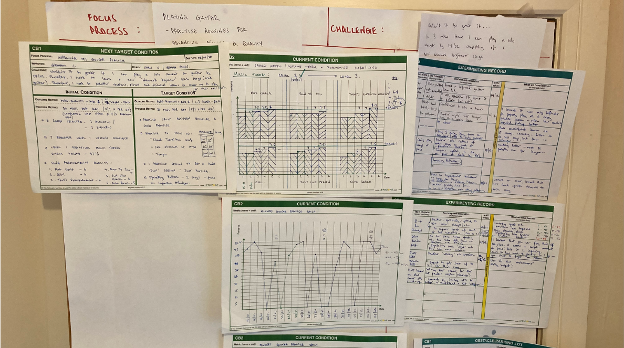
Once I reached my first Target Condition, there was a important pause for some reflection with my Coach: what did we learn about each phase of the IK? Then how to take this learning on to my next Target Condition. It was becoming apparent that having established a good ‘habit’ of practice, for 5 days out of 7 in a week, I was now ready to focus more on the elements of ‘technique’ within that practice time that were really holding me back.
Target Condition #2 – Refining the ‘Target Condition’
What has become clear to me through this project, is that moving through Target Conditions is not just about progressing in a linear way towards your Challenge. What worked in getting to my first Target Condition wasn’t going to work to get me to the next. More of the same would’ve been a mistake! The focus on my Target Condition was now about playing with ‘precision’ first, then ‘tempo’. And it was important that the patterns of practice I had defined in my Target Condition allowed time to have a bit of fun too. What would be the enjoyment in just doing lots and lots of exercises if you can’t play the odd tune for fun now and again. One of my practice sessions was allocated exclusively for just messing about with stuff.
Target Condition #3 – Taking ‘Deliberate Practice’ to a whole new level.
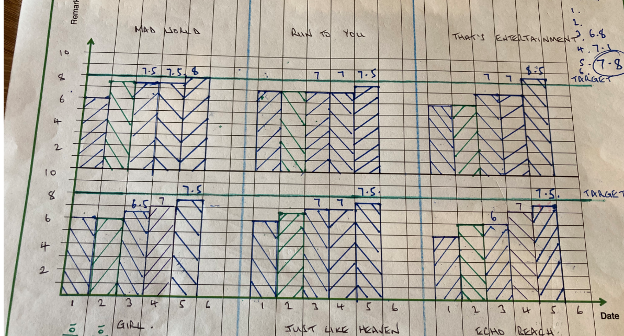
At the next stage, my obstacles were now starting to become much more specific. To be able to play the songs that I was starting to put together for the big gig, I needed to focus in much more detail on specific chord changes and riffs. Overcoming the obstacles of playing these sections properly required me to focus on small segments of each song, to work out what I could do to improve in that area and try different experiments to see what worked. This really reinforced the idea of ‘deliberate practice’ to me. It wasn’t going to be enough to keep playing the entire songs from start to finish, if they sounded disjointed and my skill level meant that they just broke down. Deliberate practice of the sections that were causing me problems, with focus on what I needed to do to master them, was the best way to improve.
Another great example of a ‘micro-learning’ was experimenting with different picks (or plectrums as they are sometimes called). Some tunes just sounded better with a thicker pick, especially those tunes I wanted to play on the electric guitar.
‘The gig’
So, did I deliver on my promise of the concert? Check the YouTube video below to see.
So, What Else Did I Learn?
The Improvement Kata works. Even in a situation of a personal challenge, that’s not a well-defined, repeatable process. I couldn’t have got to even this point though without the help of a Coach (all 3 of them!).
Sometimes an ‘experiment’ worked. But it was then necessary to build this into new practice routines in order to lock this improvement in place. This slowed the cadence of running experiments down sometimes. You must build on solid foundations, and this takes time. Daily experiments worked sometimes and didn’t work at other times. It would have been wrong for a Coach to ‘insist’ on a daily cadence of experimentation. It depended – at least for this challenge – on the obstacle and the experiment. What was more important was deliberate practice.
I over-extended myself when setting my final Target Condition. I wanted to improve my knowledge of musical theory, and thought I had capacity to do this. It didn’t really help me to reach my Challenge, so perhaps I and my Coaches should’ve questioned this. When it came down to making sure the songs were at least in reasonable shape for the gig, this goal was dropped. Perhaps, it didn’t need to be there in the first place?
So, now I have a well-established habit of ‘deliberate practice’ I’m focusing on becoming an even better guitar player. And I’m working my way through my Level 3 Music Theory – and loving actually understanding, for the first time, the theory behind the set up of the guitar. I hope it’s a lifetime of learning and discovery from here!
Kata helps with the journey to Mastery. Just getting to the point of the ‘threshold of knowledge’ and the process of experimentation helps to develop a profound understanding of the process you are working on. What a gift to give your teams! That is truly at the core of being a Learning Organisation. Perhaps I’ll blog about that next Time. But for now, I’ll leave the last word to my technical coach, Justin Sandercoe:
“The secret to becoming a guitar player is not rushing to get there. It’s enjoying the process! If you have fun on your journey, you’ll enjoy each second of it and you’ll always be aiming for more. Just have patience – and trust the process.”
See, I told you he was a Kata Geek!
Take care everyone.
Graham
If you are interested in finding out more about Toyota Kata and Scientific Thinking, drop me a line at grahamc@leanfsl.com, and we’ll fix up a call. Or join me at Katacon Europe in April (https://kataschool.org.uk/events/katacon-europe/).


