

Hello everyone, Graham here.
Can you remember when we used to send postcards to friends and family from our lovely sunny holiday locations, and then find we arrived home about two weeks before the postcards arrived? Well. This blog is a modern take on those experiences from another time! I’ve been meaning to write this article for about 3 weeks and have finally got around to it!
In early May this year (2022) I made a short trip to the lovely city of Copenhagen to meet-up with fellow Kata Geeks for a 1-day ‘get together’ and mini-workshop. I wanted to share with you my own experiences, learnings, and reflections, from what turned out to be a day that was packed with great insights and content, all held in a wonderful spirit of friendship and fun.
So, let me share with you what I learned from the trip.
The day was opened by an introduction and thought-provoking talk from Tilo Schwarz. I’ve worked so closely with Tilo over the past two years, that it was almost unimaginable to think that this was the first time we had actually met in person! I can’t begin to tell you how much I’ve learned from Tilo since I started to work with him, and his presentation was no exception.
Tilo presented that idea that we shouldn’t be too judgmental or dismissive of the conventional ‘thinking patterns’ that usually drive management behaviour and decision-making. You know the sort of thing; jumping to conclusions, making assumptions, using previous experience to ‘fix’ things using solutions that worked last time. These ‘heuristics’ (rules of thumb, if you will), can be – and have been – a super-power for survival in the past. But are they the best approach for managing through the challenges we have today, with their unprecedented levels uncertainty and incomplete information? Of course, we all believe we know the answer, but Tilo also stressed that the mental effort required to ‘overcome’ these biases is quite high. So, the best way – maybe even the only way – is to practice scientific thinking every day, with the support of a Coach.
Tilo suggested too asking a great question to leaders of organizations – who might think they are or want to develop managers as Coaches.
“What kind of Coaches do you want your manager’s to be?”. Ouch, I can picture quite few people squirming when they’re asked that question!
How about a great answer to that question being something like?
To help individuals achieve something, whilst…
Developing an organisational habit of thinking scientifically.
Not a bad start to the day, eh?
Up next was the ‘main man’ himself, Mr. Mike Rother, dialing in from Germany. Mike had some great insights to share on the early days of the research into the leadership behaviours at Toyota, and the subsequent development of Toyota Kata. I was especially taken by Mike’s thoughts on how brain science developments had met the Toyota Kata research findings half-way. Effectiveness in habitualising thinking scientifically comes from:
Practice Routines – using Starter Kata (to the letter initially)
Frequent Practice – daily is good, but more frequently is even better
A sense of Purpose – something meaningful that we as learners can really get behind
Coaching – and this includes intervention and ‘course correction’, especially in the early stages
Mastery – we need to feel like we are making progress, success along the way leads to more success
I was interested in how Mike said that he had deliberately kept the explanation and structure of the IK simple from the beginning (it’s not, nor was it ever, intended to be the Scientific Method, for example), so that we could encourage anyone and everyone to practice scientific thinking. The ‘barrier to entry’ on this stuff has been set deliberately low. A great move in my opinion, but apparently not everyone sees it the same way. It’s not Six Sigma, that’s for sure!!
Mike reinforced some of Tilo’s earlier observations, about the difficulty we all have about staying in the scientific thinking ‘zone’. As he said, “Even the best scientists jump to conclusions, but the difference is, they catch themselves when they do it!”.
How to follow that?
Well, that unenviable tasks fell to Pia Anhede and Johan Häggström (Director of Manufacturing Excellence at Getinge Group). They did a pretty good job too. The Kata community needs more ‘evangelists’ like Johan. He is building TK into a substantial transformation programme at a big, multi-site enterprise. For TK to become more mainstream, it needs people like Johan showing how, building in the Leaders as Coaches concept and scientific thinking patterns, really ‘turbo-charge’ lean and CI activity. I really liked the way that the generation of a site’s Future State became the Challenge for the local leadership team. I also liked the way that they have navigated through some of the initial confusion about building the TK Starter Kata into a pre-existing A3 problem-solving approach. In a nutshell, if it’s a ‘deviation-driven’ issue they use A3, if it’s a ‘challenge-driven’ opportunity, then its Kata. Kudos to Johan and Pia for this bold and impressive programme of work!
Next up, a real change in direction, in the form of the fantastic Vibeke Hatting, and her colleagues Klaus and Marianne Müller-Nielsen, from the Psychiatry team that covers the whole of southern Denmark. I really loved getting to try some of the music-related routines that they use with patients to get them in a good place to open up and lose some fear and inhibition. Very different to my paradigms, but it’s always good to see and try something else. As Klaus said, “It’s always easier to find a creative solution when you are in a good mood!”.
The South Denmark Psychiatry team have been using Kata for 4 or 5 years now, and it was fascinating to see how they are training all their leaders to use Toyota Kata as both Improvers and Coaches. A key part of their challenge has been to ensure that leaders stay humble and be the first to admit their mistakes and to show some vulnerability. Change must affect those at the top too, it’s not enough for it to be good enough for others but not them.
The next point that really resonated with me came from Klaus, again:
“When faced with Fear, humans react in 1 of three ways. Fight, Flight or Freeze. 80% of the time, the response is one of the last two categories. Either way, there isn’t much opportunity to learn!”.
‘Psychological Safety’ has become a bit of a buzzword recently, and it’s all too easy to pay lip-service to the idea; but we must – with conviction and humility – ensure that people are in that place of safety, and they feel they can tell you when they aren’t, and you will act on that signal. This is such an important factor to remember when we engage with new Learners as their Coaches.
My final little nugget from Vibeke and her colleagues. We assume that clinicians – with their usual background in medicine and science – will ‘think’ scientifically. Apparently not. Klaus again with another magical quote:
“Doctors are actually educated to jump to conclusions! How about actually asking the patient, ‘what is the outcome that you really want?’”.
All of this was before lunch by the way. Talk about a packed agenda!
In the afternoon, we broke into groups for some team-based activity to develop some ideas and hypotheses about how TK can help meet the future challenges humanity faces. No small challenge there then!
When asked the question (posed, intriguingly, by Mike Rother himself):
“What is the problem to be solved with Kata?”
Our team came up with the following (quite neat in my opinion) theoretical model.
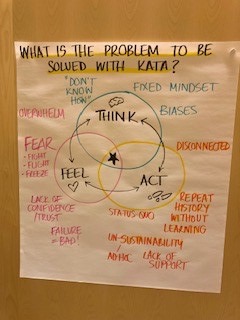 Thank you especially to the wonderful Gemma Jones for her help leading this mini workshop. Quite a daunting question to try and answer. And to get to where we did, and to present something as coherent as what you can see in the picture, was down to Gemma’s fantastic facilitation and visual skills! Thanks Gem!
There was so much shared learning, warmth, and friendship across the whole day. A real highlight for me, and probably the main reason for me to travel to Denmark, was the opportunity to meet people I had only met on a computer screen. And to round off the end of such a valuable day, we had a very nice group dinner in the evening, in Tivoli Gardens, in the centre of Copenhagen. Many thanks to Joakim Hillberg for organizing an excellent evening to complement a great day. Very, very good Smørrebrød, and wonderful company!
So, before finishing this rather long postcard from Copenhagen, I wanted to say a special mention and ‘thank you’ to three other people who made my trip such a fantastic experience. Firstly, it was a wonderful surprise to bump into TWI and Kata Expert Coach, Joakim Bjurström at the meet-up. Joakim played a huge part in my early learning and experimentation with TK, and I still use the classroom simulation he developed as part of my ‘in person’ Improvement Kata training courses. I really hope to keep in touch with him more closely over the coming weeks and months. My final ‘thank you’ goes to Aleks Drenovac and Dejan Tomic from Kata School Serbia. They were my companions throughout the two days I spent in Copenhagen and were just such great fun to be with! It’s an honour to have got to know them a little bit better during our time together, and to be able to think of them as newly made friends! Thanks guys, it was an absolute blast!!
I hope you enjoyed some of my reflections and learnings. Let me know your thoughts?
Take care. Graham


